Prices & Examples(CKB-North1)
Billing prices
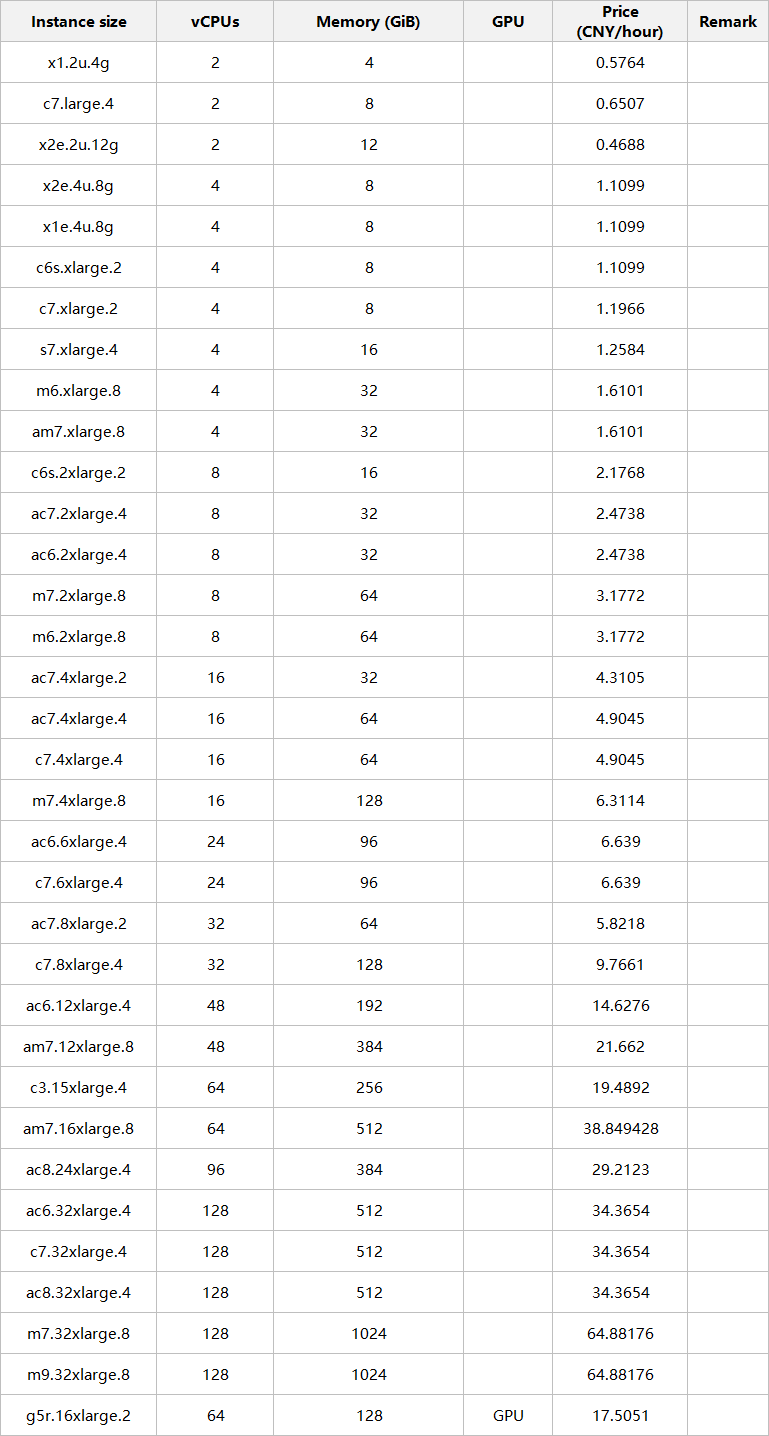
Compute charge unit price
Storage charge unit price

Note: Hourly unit price = Monthly unit price/30 (days)/24 (hours)
Download charge unit price

Billing examples
Analysis Charges
Analysis charges consist of compute charges and subscription charges.
Compute Charges are charged based on the "duration of occupation of a computing node with a certain specific configuration (instance specification)." If a task involves multiple steps, the platform will calculate the compute charges for each step and then sum up the charges of all steps to obtain the total compute charges for the current task. Subscription charges are levied according to the charges specified by the platform or the creator based on the number of task executions.
Currently, only compute charges are collected for analysis online and offline tasks. For other analysis tasks (workflow analysis), depending on the charging method and task status, the analysis charges are calculated as follows:
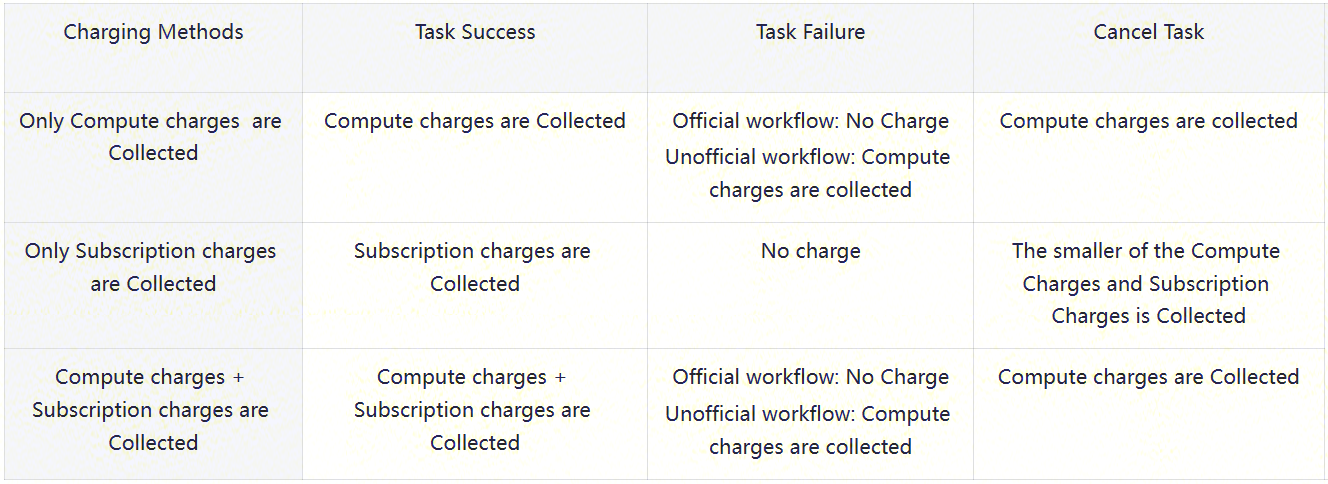
The definition of official workflow can be found in: Definitions.
Example 1: Billing for tasks with only compute charges collected
1)Task Success: Suppose you submit a workflow analysis task on the platform, and only compute charges are collected for this task. The task consists of 5 steps. The table below assumes the configurations used and the running durations, and based on these, the task analysis charge is calculated to be 31.18 CNY.
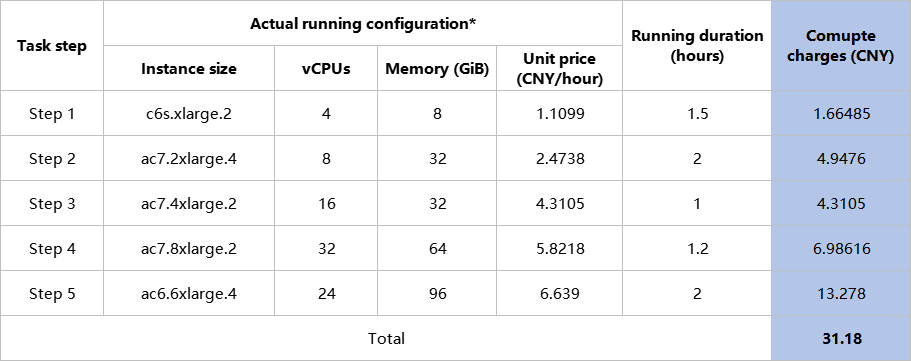
Note:Actual running configuration may differ from your requested configuration. For reference, see: Definitions.
2)Task Failure:
If in the above example, the task you submitted is a platform's official workflow task and it fails during step 3, the analysis charge will be 0. If in the above example, the task you submitted is a non-platform official workflow task and it fails during step 3, only the analysis charges of step 1 and step 2 will be calculated, amounting to 6.61 CNY.
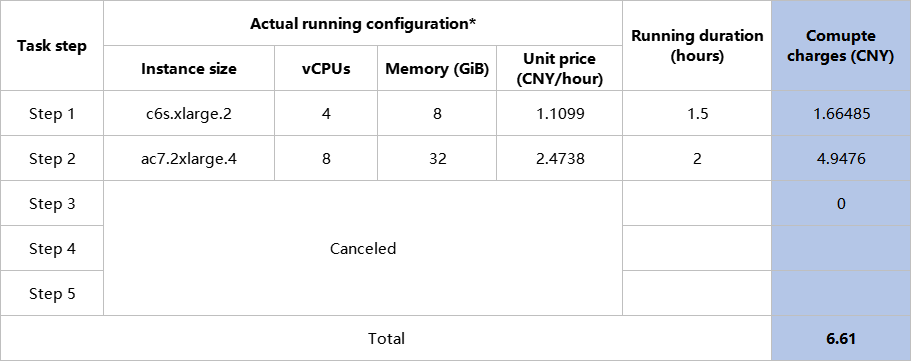
3)Task Cancellation: If in the above example, you cancel the task during step 3, only the analysis charges of step 1 and step 2 will be calculated, amounting to 6.61 CNY.
Example 2: Billing for tasks with only subscription charges collected
Suppose you submit a workflow analysis task on the platform, and only subscription charges are collected for this task. The pricing of this workflow is 70 yuan and no discount gradient is set. The analysis charges for different task statuses are calculated as follows:
1)Task Completion: The analysis charge is the subscription charge, which is 70 CNY.
2)Task Failure: No analysis charge is charged, so it is 0.
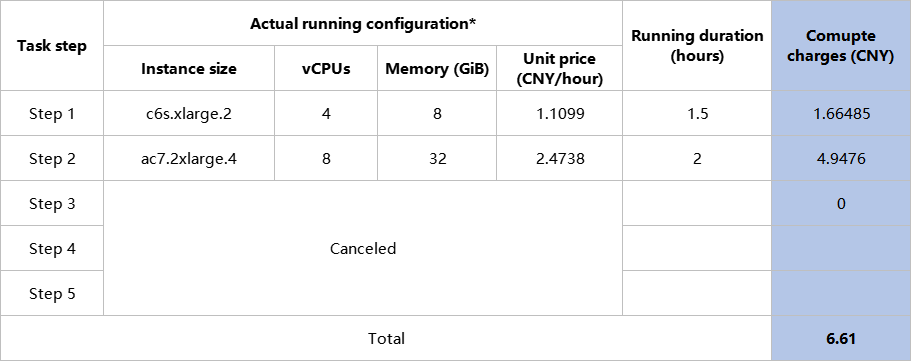
3)Task Cancellation: Suppose when you cancel the task, the compute charges are as shown in the following table. Since the compute charges are less than the subscription charge, the analysis charge is the smaller amount, which is 6.61 CNY. Conversely, if the compute charges are greater than the subscription charge when cancelled, the analysis charge is the subscription charge, which is 70 CNY.
Example 3: Billing for tasks with compute charges +subscription charges collected
Suppose you submit a workflow analysis task on the platform, and the charging method for this task is to collect both compute charges and subscription charges. Assume the subscription charge is 21 and the compute charges are as shown in the following table. Based on this, the analysis charges for different task statuses are calculated as follows:
1)Task Completion: The analysis charge is the sum of the compute charges and the subscription charges, which is 21 + 12.7, that is 33.7 CNY.
2)Task Failure: If the workflow is an official workflow, no fee will be charged, and the analysis charge will be 0; If it is a non-official workflow, compute charges will be charged, amounting to 12.7 CNY.
3)Task Cancellation: Compute charges for the analysis will be charged, amounting to 12.7 CNY.
Suppose the compute charges when the task is completed are as follows:

Example 4: Billing for Analysis tasks
Suppose you submitted a notebook analysis task on the platform. The table below assumes billing conditions and calculates the analysis charge for the task to be 6.53 CNY.

Storage Charges
Computational storage charges are charged based on storage size and duration. Storage size is calculated based on the file size at the time of billing. If multiple files are generated during a task's runtime, the storage size of all files at the billing point is summed to calculate the computational storage size. Data storage charges are charged based on the size of the file and duration.
Storage charges are calculated with a minimum storage duration of 1 hour.
Example 1:Data storage charges generated by storing files
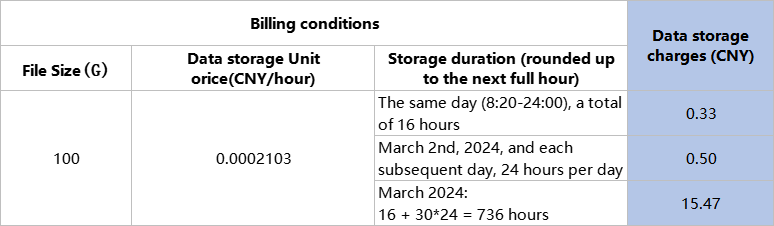
If you uploaded a 100G file to your Project A on the platform at 8:20 AM on March 1st, 2024, and there are no other data files in that project, then the data storage charges for Project A with different storage durations are as detailed in the following table.
Example 2: Computational storage charges generated from task submission
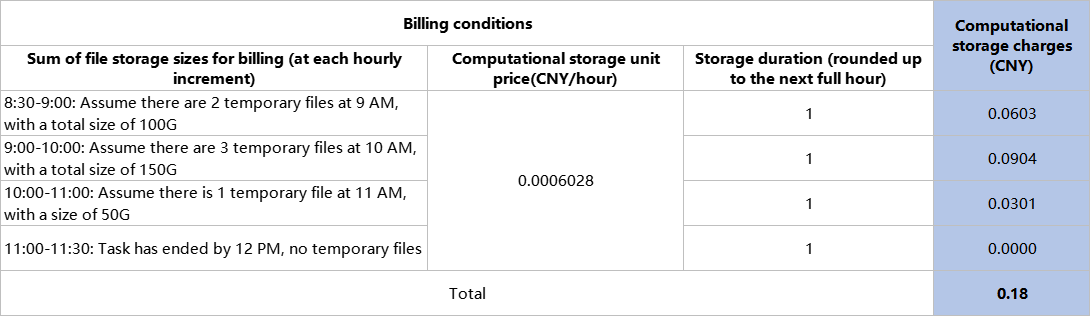
Suppose that on March 1st, 2024, at 8:30 AM, you submitted an analysis task for Project B on the platform, and the task ended at 11:30 AM, with no other analysis tasks during that period. The table below assumes billing conditions and accordingly calculates the computational storage charges for Project B during this period to be 0.18 CNY.
Example 3: Calculation of daily storage charges generated by file storage and task submission
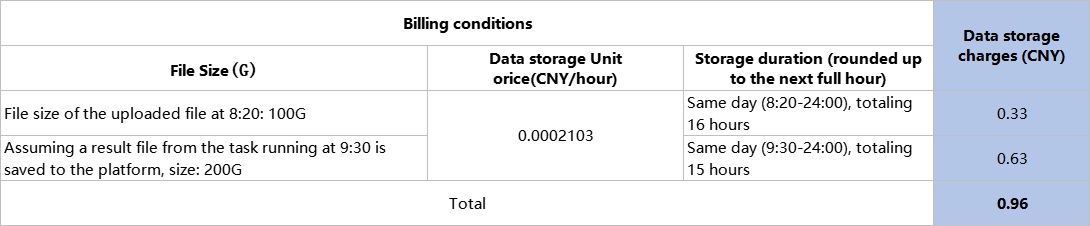
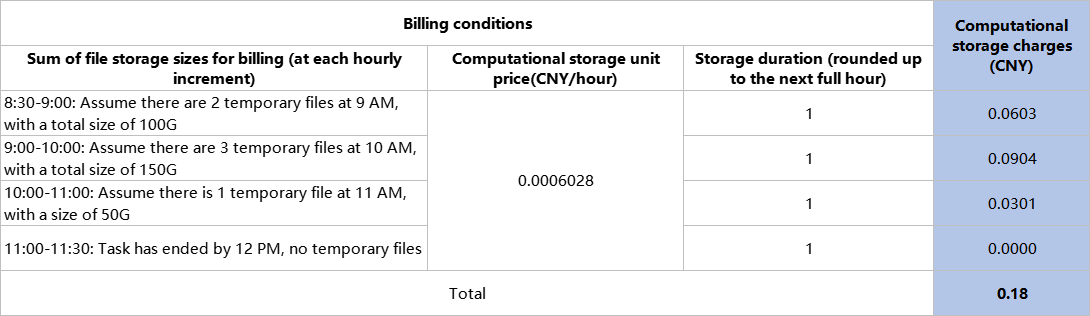
Assuming that you uploaded a 100G file to your Project C on the platform at 8:20 AM on March 1, 2024, and at 8:30 you submitted a standard analysis task based on that file. The two tables below assume billing conditions and accordingly calculate Project C's data storage charges and computational storage charges for that day. Therefore, the total storage charges for Project C for that day would be 1.14 CNY after adding both.
Data storage charge:
Computational Storage charge:
Download Charges
Download charges are charged based on the outbound traffic of downloaded/transferred files. Multiple downloads of the same file will generate multiple traffic volumes, and download charges will be calculated accordingly.
Example 1:Download charges
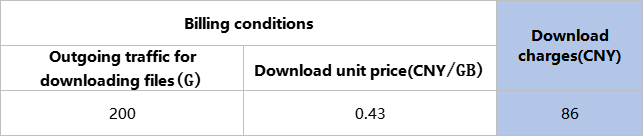
Suppose you download a file from the platform, and the operation results in a total outgoing traffic of 200G, then the download charge would be 86 CNY, as shown in the table below.
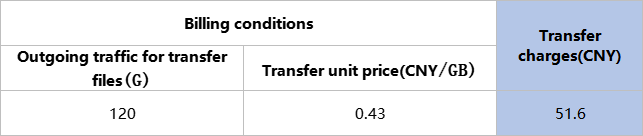
Example 2: Transfer charges
If you successfully copy a 120GB file from Project A in the DCS-South1 to Project B in the BGI-Cneter on the platform, a transfer charge of 51.6 CNY will be incurred for Project A, as shown in the following table.